
Your AUSTEDO XR story
deserves
to be seen
Sharing your experience could help others feel
more connected, empowered, and informed.
for HD Chorea in Adults
Now Playing:
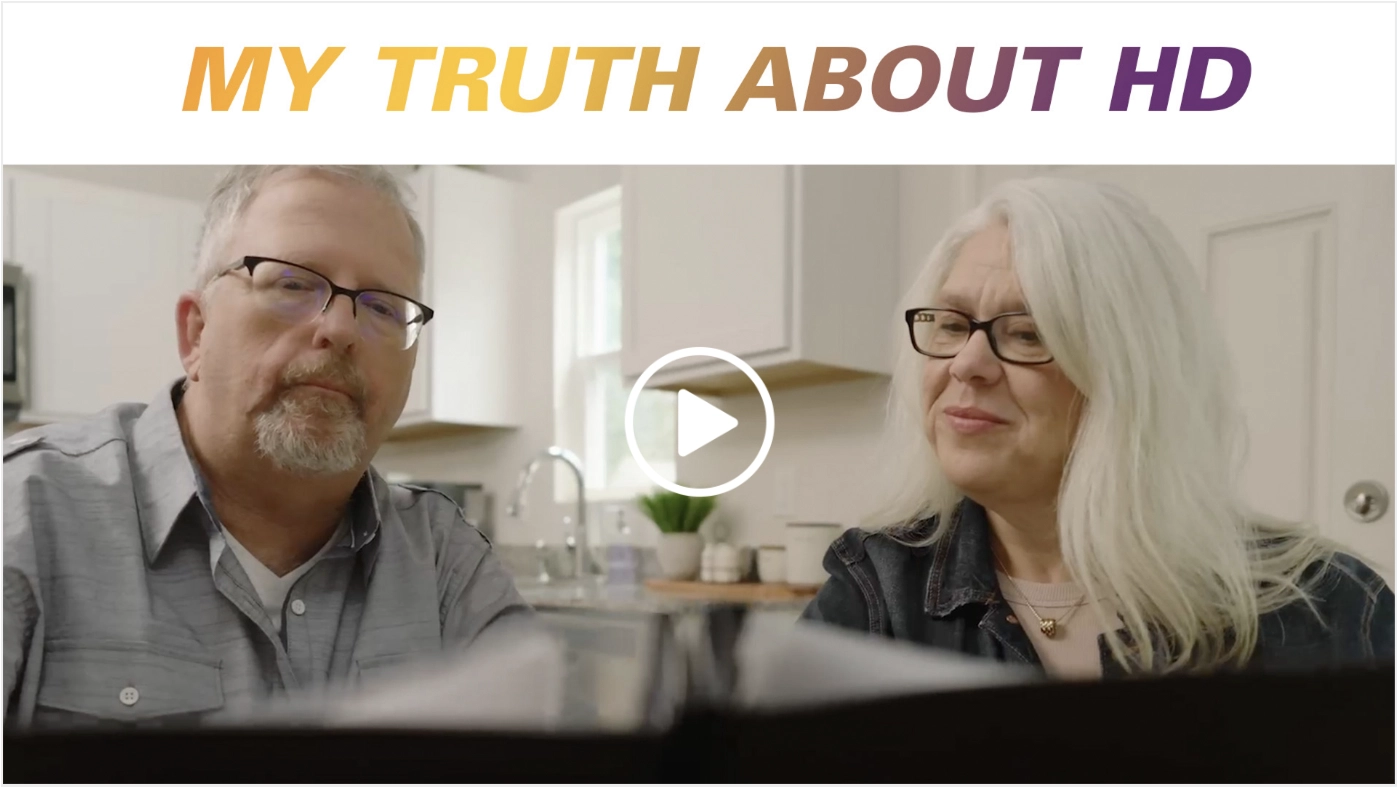
Renee and Karen’s Story
Hear Karen and Renee discuss their experience facing HD chorea together and finding a way forward. View their full story or select a specific milestone from the chapters in the dropdown menu.
View transcript
Meet Renee and Karen
Facing HD Together
Holding on to Independence
A Way Forward
Strength Through Connection
Recognizing the Signs
Providing Care
Planning Ahead
Meet James and Sue
Learning About HD Chorea
The Impact of HD Chorea
The Path to Treatment
HD Chorea Awareness
Renee and Karen’s Story

The importance of treating
HD chorea early
James and Sue’s Story

See why Ray and Rhonda made the decision to treat HD chorea

See how AUSTEDO helped reduce Ray’s HD chorea
Understanding the
burden of HD chorea

View transcript
KAREN: Growing up, Renee was very busy. She loved to ride her bike, and she did it from daylight until dark.
RENEE: I loved riding my bicycle, I loved soccer.
KAREN: We didn't know Huntington’s was in the family until Renee’s dad was diagnosed.
When we first received the diagnosis, it was at a younger age than most.
RENEE: I was 30 when I found out.
KAREN: When Renee got the official diagnosis, I knew immediately I would have to change jobs so that I could be home to take care of her.
She went through a very hard time and her kids did too. It was very traumatic for them.
Huntington’s disease is devastating. It’s also very isolating, so the support groups are essential.
My grandkids, I try to just be a grandmother to them and let them live their lives and make their own decisions.
Huntington’s has definitely brought us closer together.
The first signs of chorea that I noticed, and I think I was the first to notice those, is she became a little jerky with her arms.
They were not that noticeable, but I noticed them.
She did start choking, you don't realize it, but it affects the esophagus as well.
As the symptoms started to appear, I knew that I would have to have a conversation with her.
When chorea really becomes apparent, it affects every aspect of your daily life.
RENEE: I was devastated.
KAREN: It gradually began to affect her walking, she had to stop driving. And that was very difficult for her as well, she was so independent and
for quite some time she wanted to deny it.
But eventually, she did have to face it.
Before treatment began, the movements had affected her ability to even put on makeup, fix her hair.
Her general independence, which she cherished, had been taken away from her.
I didn't know about treatment for chorea initially, after six months her physician decided to start her on AUSTEDO.
AUSTEDO XR is a prescription medicine used to treat chorea associated with Huntington’s disease in adults.
AUSTEDO helped almost immediately with her movements, and it was just a huge relief to us.
RENEE: It made me feel good.
KAREN: She was then able to eat without choking, and she was able to help her kids in the mornings get ready for school.
If I had known about AUSTEDO earlier, I would have started immediately.
Huntington’s is a progressive disease, and your involuntary movements do grow worse over time.
Treating chorea as early as possible is ultimately the game changer, she was able to continue her life with her friends,
she didn't feel so awkward.
It really gave her some hope
RENEE: I love it.
KAREN: It's always been Renee’s goal as well as mine to educate people on Huntington’s that don't know about it.
I think it's very important for Renee and I to share her story and the life she's lived and the things she's learned.
I partake in quite a few groups for Huntington’s caregivers.
Anytime there's questions asked about the involuntary movements, I try to always let them know her experience with AUSTEDO and how it's helped her.
I think if I were to give other caregivers any tips in speaking with their physician, ask what's available for your patient, your loved one, is AUSTEDO available?
There is some hope available for the movements that's the key to everything.
It's a huge honor and pleasure to take care of her, and I can't see myself doing anything else.
Cherish every moment that you have with your loved one and fight as hard as you can for them,
Whether it be AUSTEDO, movements, anything in their life. Fight for them and take care of them and cherish every minute of it.
VOICEOVER: AUSTEDO XR can cause depression, suicidal thoughts, or actions in patients with Huntington’s disease.
Pay close attention to and call your doctor if you become depressed, have sudden changes in mood, or have suicidal thoughts.
Don't take if you have liver problems, are taking reserpine, tetrabenazine or valbenazine.
AUSTEDO XR may cause irregular or fast heartbeat or abnormal movements.
Seek help for fever, stiff muscles, problems thinking or sweating.
Common side effects include sleepiness, diarrhea, tiredness, and dry mouth.
If you're experiencing uncontrollable movements from HD chorea, ask a doctor about AUSTEDO XR.
In bed, he would be kicking me or hitting, and then it just moved on to while he was sleeping, he was just flailing around, moving his arms and legs.
So, what motivated us to talk to the doctor about the movements was, ultimately, when he dislocated his shoulder. I just kind of felt like something needed to change. We didn't know if there was anything that could be done, but we knew that we needed to figure that out.
If I knew of somebody that had HD chorea, I would just talk to them about not waiting like we did. Reading as much as they can, talking to people, searching people out. I would ask them to really advocate for themselves. Especially with the chorea, because that is something you can't hide and it affects all of your activities. It makes just living very difficult.
So, I go to all the doctor's appointments with Ray so that I can help advocate for him. Sometimes, he doesn't realize various symptoms or feel the need to get them managed. So, for the chorea, I feel like sometimes the person actually with HD does not realize that they have the chorea, especially in the beginning.
By the time we went to the doctor for his chorea, I feel like we were a little bit beyond frustrated and stressed about them. And so I feel like we went, and I was advocating big time on anything that could help. We went much later than we should have.
We should have talked to her much sooner about the chorea before it got out of control like it did. And so, I would ask somebody else to advocate much better for their loved one early on.
So, as the movements progressed more and more, I was thinking about planning in my head what steps we would need to take, basically just to keep him safe and the rest of our house safe, and different equipment he might need.
What equipment he would need for, say, getting dressed or taking a shower. Or if he would need a wheelchair, getting a wheelchair ramp made, getting a deck put on the back so that he could still go outside once he was in a wheelchair.
Just things that I was planning in my head and I still think about on a daily basis... just trying to keep one step ahead of what he might need.
The advice I would give somebody that is a caregiver to somebody that has HD and chorea would be to make sure and get some time for yourself. Take care of yourself, however that looks for you, but make sure you do that sooner, early on, because it can be a lot.
AUSTEDO XR is a prescription medicine used to treat chorea associated with Huntington's disease in adults.
AUSTEDO XR can cause depression, suicidal thoughts, or actions in patients with Huntington's disease. Pay close attention to and call your doctor if you become depressed, have sudden changes in mood, or have suicidal thoughts. Don't take if you have liver problems, are taking reserpine, tetrabenazine, or valbenazine. AUSTEDO XR may cause irregular or fast heartbeat, or abnormal movements. Seek help for fever, stiff muscles, problems thinking, or sweating. Common side effects include inflammation of the nose and throat, insomnia and sleepiness.
James: My name is James, and I am 73 years old.
Sue: My name is Sue, and I am 75 years old.
James: I met Sue in 1969 in the dining hall at the University of Rhode Island.
Sue: He was the love of my life. And we've been married 51 wonderful years.
James: I first learned about Huntington's disease at the age of 57. It was in my family. My mom had a lot of movements. I decided to get tested. I wanted to rule it out for our children. When I was diagnosed, with Huntington's disease, you know, it was certainly a surprise.
Sue: I didn't think he would test positive because he didn't have the signs. He didn't have symptoms.
James: I first started feeling symptoms probably 5 or 6 years after the genetic test. When I first started to experience chorea symptoms, I had a twitching in my toe. So, I could tell that that was the start of chorea.
Sue: It's difficult to describe the feelings that I felt. And then realizing that this is really happening, was kind of sad.
James: The feet started to move along the legs and lower body and then, twitching of the fingers. So, years went by and it gradually got worse. The HD chorea affected my independence because of the movements in my fingers. They were gradually getting worse over time. Made it difficult to hit a keyboard accurately. There is a stigma involved, which has been associated with the movements. They can be embarrassing in public. AUSTEDO has helped me with several of my movements. It has been very helpful. It was pretty quickly that I noticed the results. I do feel more independent. I do feel better that people don’t notice.
Sue: AUSTEDO has helped James greatly, since he started with the movements, and he’s able to do so many things. And when people meet him, they don’t even know he has Huntington’s because he doesn’t have that movement. Treating chorea early is important. Since James started with the AUSTEDO, I noticed a change in the movements of his legs which has been awesome and wonderful for both of us.
James: AUSTEDO is easy to use and stay on over time. It’s in pill form. I’m on a few other medications that I can take them with AUSTEDO.
Sue: I would definitely recommend AUSTEDO for anyone I know whose loved one is suffering with chorea and really needs the help to minimize the movements.
Sue: I got involved in 2006 and I started volunteering and learned about resources and learned about the testing where he decided to get tested, and the resources that I learned about really helped with processing the outcomes of his test being positive. What I would say to people about addressing the chorea symptoms of Huntington's, is to have a good care team. You need someone that knows about Huntington's, you need a neurologist who can refer you to the right medications and definitely have them prescribe AUSTEDO to help them with the chorea.
James: Since I’ve decided to seek treatment, life has been better I would say, overall because I do appreciate every day as much as possible. You learn that lesson pretty quickly when they give you the news, there are things you can do. If I’m talking to someone else with HD chorea, I would recommend that they try AUSTEDO. Certainly, speak to their doctor about it, it’s an easy-to-take medication and very effective in pill form.
AUSTEDO XR is a prescription medicine used to treat chorea associated with Huntington's disease in adults. AUSTEDO XR can cause depression, suicidal thoughts, or actions in patients with Huntington’s disease. Pay close attention to and call your doctor if you become depressed, have sudden changes in mood, or have suicidal thoughts. Don’t take if you have liver problems, are taking reserpine, tetrabenazine, or valbenazine. AUSTEDO XR may cause irregular or fast heartbeat, or abnormal movements. Seek help for fever, stiff muscles, problems thinking, or sweating. Common side effects include sleepiness, diarrhea, tiredness, and dry mouth.
APPROVED USES
AUSTEDO® XR (deutetrabenazine) extended-release tablets and AUSTEDO® (deutetrabenazine) tablets are prescription medicines that are used to treat:
the involuntary movements (chorea) of Huntington’s disease. AUSTEDO XR and AUSTEDO do not cure the cause of the involuntary movements, and it does not treat other symptoms of Huntington’s disease, such as problems with thinking or emotions.
movements in the face, tongue, or other body parts that cannot be controlled (tardive dyskinesia).
It is not known if AUSTEDO XR and AUSTEDO are safe and effective in children.
IMPORTANT SAFETY INFORMATION
AUSTEDO XR and AUSTEDO can cause serious side effects in people with Huntington’s disease, including: depression, suicidal thoughts, or suicidal actions. Do not start taking AUSTEDO XR or AUSTEDO if you are depressed (have untreated depression or depression that is not well controlled by medicine) or have suicidal thoughts. Pay close attention to any changes, especially sudden changes, in mood, behaviors, thoughts or feelings. This is especially important when AUSTEDO XR or AUSTEDO is started and when the dose is changed. Call your healthcare provider right away if you become depressed, have unusual changes in mood or behavior, or have thoughts of suicide.
Do not take AUSTEDO XR or AUSTEDO if you:
have Huntington’s disease and are depressed or have thoughts of suicide.
have liver problems.
are taking reserpine. Do not take medicines that contain reserpine with AUSTEDO XR or AUSTEDO. If your healthcare provider plans to switch you from taking reserpine to AUSTEDO XR or AUSTEDO, you must wait at least 20 days after your last dose of reserpine before you start taking AUSTEDO XR or AUSTEDO.
are taking a monoamine oxidase inhibitor (MAOI) medicine. Do not take an MAOI within 14 days after you stop taking AUSTEDO XR or AUSTEDO. Do not start AUSTEDO XR or AUSTEDO if you stopped taking an MAOI in the last 14 days. Ask your healthcare provider or pharmacist if you are not sure.
are taking tetrabenazine. If your healthcare provider plans to switch you from tetrabenazine to AUSTEDO XR or AUSTEDO, take your first dose of AUSTEDO XR or AUSTEDO on the day after your last dose of tetrabenazine.
are taking valbenazine.
Other possible serious side effects include:
Irregular heartbeat (QT prolongation). AUSTEDO XR and AUSTEDO increases your chance of having certain changes in the electrical activity in your heart. These changes can lead to a dangerous abnormal heartbeat. Taking AUSTEDO XR or AUSTEDO with certain medicines may increase this chance.
Neuroleptic Malignant Syndrome. Call your healthcare provider right away and go to the nearest emergency room if you develop these signs and symptoms that do not have another obvious cause: high fever, stiff muscles, problems thinking, very fast or uneven heartbeat, or increased sweating.
Restlessness. You may get a condition where you feel a strong urge to move. This is called akathisia.
Parkinsonism. Symptoms include: slight shaking, body stiffness, trouble moving, trouble keeping your balance, or falls.
Sleepiness (sedation) is a common side effect of AUSTEDO XR and AUSTEDO. While taking AUSTEDO XR or AUSTEDO, do not drive a car or operate dangerous machinery until you know how AUSTEDO XR or AUSTEDO affects you. Drinking alcohol and taking other drugs that may also cause sleepiness while you are taking AUSTEDO XR or AUSTEDO may increase any sleepiness caused by AUSTEDO XR and AUSTEDO. The most common side effects of AUSTEDO in people with Huntington’s disease include sleepiness (sedation), diarrhea, tiredness, and dry mouth.
The most common side effects of AUSTEDO in people with tardive dyskinesia include inflammation of the nose and throat (nasopharyngitis) and problems sleeping (insomnia). The most common side effects of AUSTEDO XR are expected to be similar to AUSTEDO in people with Huntington’s disease or tardive dyskinesia. These are not all the possible side effects of AUSTEDO XR or AUSTEDO. Call your doctor for medical advice about side effects. You are encouraged to report side effects of prescription drugs to the FDA. Visit www.fda.gov/medwatch or call 1-800-FDA-1088. Please read the accompanying Medication Guide.
Ray
I'm Ray. I'm 55.
Rhonda
My name is Rhonda, and I am Ray's wife.
Rhonda
Ray's dad had Huntington's disease. He wasn’t, wasn't able to walk. He ended up in a wheelchair. So that was kind of a really scary thought for me. I just assumed that our lives would be over very soon as we knew it.
Rhonda
So the first symptoms I noticed of his chorea was at night while he was sleeping, his arms would, you know, kind of start flailing and hitting and kind of it would just be like his whole body.
Ray
When I was driving to work one day, my hands started just shaking like this. It’s just weird you know, having your hands move and no, no explanation.
Rhonda
At that time. It was I was feeling a little bit desperate, like something needs to change. We can't do this anymore.
Rhonda
We made an appointment with the neurologist that week talking to her about how bad it had gotten, and she said, well, I have this drug that I would like for you to try.
Rhonda
Yeah, so his movements just became less and less as the doses increased. His sleeping now is very different. No more kicks, no more punches, no more flailing around in bed. We both noticed that small things that he would do with his hands became easier.
Ray
Yeah.
Rhonda
Buttoning his shirt, putting the leash on the dog's collar, tying his shoes. Those things became easier. So, yeah, it has far exceeded our expectations.
Rhonda
We're looking forward to taking a trip to Yellowstone. Hopefully taking our grandkids and doing some hiking. I don't know that we would have been able to continue hiking with his chorea had it continued on without the medication. I feel like that we're actually like living the way we've always wanted to live now. By going on vacations and being outdoors a lot more and having grandkids and yeah, I can't imagine life if he didn't have the medication.
Ray
It's really a deal maker for me. It just helps so much.
APPROVED USES
AUSTEDO® XR (deutetrabenazine) extended-release tablets and AUSTEDO® (deutetrabenazine) tablets are prescription medicines that are used to treat:
the involuntary movements (chorea) of Huntington’s disease. AUSTEDO XR and AUSTEDO do not cure the cause of the involuntary movements, and it does not treat other symptoms of Huntington’s disease, such as problems with thinking or emotions.
movements in the face, tongue, or other body parts that cannot be controlled (tardive dyskinesia).
It is not known if AUSTEDO XR and AUSTEDO are safe and effective in children.
IMPORTANT SAFETY INFORMATION
AUSTEDO XR and AUSTEDO can cause serious side effects in people with Huntington’s disease, including: depression, suicidal thoughts, or suicidal actions. Do not start taking AUSTEDO XR or AUSTEDO if you are depressed (have untreated depression or depression that is not well controlled by medicine) or have suicidal thoughts. Pay close attention to any changes, especially sudden changes, in mood, behaviors, thoughts or feelings. This is especially important when AUSTEDO XR or AUSTEDO is started and when the dose is changed. Call your healthcare provider right away if you become depressed, have unusual changes in mood or behavior, or have thoughts of suicide.
Individual results may vary.
Please see the Important Safety Information at the end of this video.
Ray has Huntington’s disease chorea, which causes uncontrollable movements throughout his body. So, his doctor prescribed AUSTEDO XR, and he began noticing improvement.
AUSTEDO XR is a prescription medicine used to treat chorea associated with Huntington's disease in adults.
People taking AUSTEDO saw over 2x reduction in HD chorea vs placebo.
“AUSTEDO has definitely helped with his movements.”
AUSTEDO XR can cause depression, suicidal thoughts, or actions in patients with Huntington’s disease. Pay close attention to and call your doctor if you become depressed, have sudden changes in mood, or have suicidal thoughts. Don’t take if you have liver problems, are taking reserpine, tetrabenazine, or valbenazine. AUSTEDO XR may cause irregular or fast heartbeat, or abnormal movements. Seek help for fever, stiff muscles, problems thinking, or sweating. Common side effects include sleepiness, diarrhea, tiredness, and dry mouth.
If you're living with HD chorea, ask your doctor if AUSTEDO XR can help you like it helped Ray.
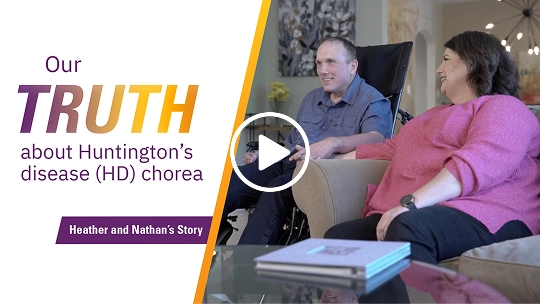
Heather:
I’m Heather. This is my husband, Nathan. Nathan and I met through his sister, one of my best friends. We adore each other. I don’t know any other way to put it.
Nathan:
I love her.
Heather:
He loves me.
I knew nothing about Huntington’s disease until I met Nathan and his sister, and they would talk about their mom having the disease—it’s very scary.
When Nathan first started needing my help, it was a bit more daunting. Our child was small, so I had them both depending on me. He depended on me a lot…
helping him walk, holding his hands. And I don’t mean the side by side holding hands, I mean I’m standing in front of him holding on to his arms to help him steady his gait.
We started seeing a difference once Nathan started AUSTEDO—he was able to hold on to tools, pick up drink cans, play with our kids. Chorea control gives me peace of mind for how I care for Nathan. I don’t feel quite as much as a caregiver. I feel more like a wife and more a partner with my husband.
The process of switching to AUSTEDO XR was so easy. It was very easy to explain the dose schedule to friends and family—you only have to take AUSTEDO XR once a day, with or without food. It made life a whole lot easier. We didn’t have to change any doses with his other medications.
We love that we can increase and decrease the dosages as needed.
With disease progression, movement control gives us a better bond because we can sit there and hold hands, we can enjoy watching a movie—we can enjoy things that we felt like we would never be able to enjoy again. He can play video games and bond with our son. We attribute AUSTEDO XR to helping him out considerably. I have my husband back a little bit again.
VO:
AUSTEDO XR can cause depression, suicidal thoughts, or actions in patients with Huntington’s disease. Pay close attention to and call your doctor if you become depressed, have sudden changes in mood, or have suicidal thoughts. Don’t take if you have liver problems, are taking reserpine, tetrabenazine, or valbenazine.
AUSTEDO XR may cause irregular or fast heartbeat, or abnormal movements. Seek help for fever, stiff muscles, problems thinking, or sweating. Common side effects include sleepiness, diarrhea, tiredness, and dry mouth.
The importance of treating
HD chorea early
James and Sue’s Story

See why Ray and Rhonda made the decision to treat HD chorea
See how AUSTEDO helped reduce Ray’s HD chorea
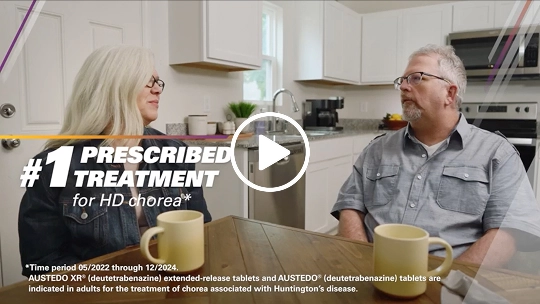
Understanding the
burden of HD chorea
Sharing your experience could help others feel
more connected, empowered, and informed.
The information on this site is intended for healthcare professionals in the United States. Are you a healthcare professional in the United States?
